Wednesday, 15 October 2014

Horror Opening Scene Analysis: Drag Me To Hell


Horror Film Opening Analysis: Drag Me To Hell
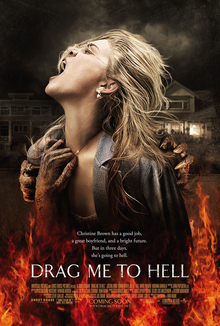
The scene starts off with a long shot of the house, which set in an isolated jungle as it is surrounded with greenery, the housing looks expensive which shows that the owner is wealthy. We know that it’s a horror genre as there in low-key lighting to show that there is some type of spirit.
There is a car driving up to the front of the house and the female character rushes out of the car, knocking loudly on the door calling the name of the owner, we can hear the panic and desperation in her voice that suggests that someone is in danger. The shot turns in a medium shot, the male character enters the scene carrying the kid in him arms, which shows that the child is unwell. We can see that the scene is set in another country as the characters are speaking another language; from the subtitle we are informed that the child has been hearing voices which keeps getting louder and something is coming after him as he committed a crime by stealing a silver necklace from the gypsy wagon. They used a medium shot to fit in all the character and see their worried expressions, they are worried as their child is unwell, and the audiences are able to emphasis with the parents. When told about the stolen necklaces, the lady with the scared expression hurries the family inside the house, the audience knows that the voices he’s hearing is going to harm him. The scene cuts into a close up of the unwell boy, we can see the frightened expression as he’s sweating and shivering his eyes widening then the audience are shown what the boy is seeing from his perspective. High angle shot is used to make the shadows of the creature’s hands dominant that makes the child feel weak and venerable; the boy tries to comfort himself by pulling on the blanket. This gesture makes the audience engage, as everyone will have feared something in our childhood and to protect ourselves we would cover ourselves with a blanket, as we believed that it would shield us from the evil. The boy is in the center of the shot which means that he’s the main focus and displays that he’s is an important character for what’s going to occur next. A hand appears on the boy’s head and his mother grabs his hand to reassure him and letting him know that he’s safe with them.

The women walks around the room sprinkling holy water and saying prayers to get rid of any evils lurking room whilst she preforms this the evil spirit enters the room pushing everything in its way, the long shot of the room show the damages showing the power of the evil. The boy runs towards toward the balcony to save himself as the camera follows him zooming in a canted angle into his screaming facial expression as he reaches the edge of the balcony. Once the boy is lifted into the air the audience will have an idea of what going to happen to him then we see the scene from the women’s perspective of the boy lying flat on the ground suggesting that he either dead or seriously injured from the fall. The camera cuts into a medium shot of the women and his parents showing the fear in their faces as they boy tries to get up. Whilst the boy tries to escape, birdseye view is used so the audiences are able to see the cracks on the floor that shows that underneath him is hell. The camera pans towards the women as she watching the boy being pulled by the large hand, to make it seem sinister the camera moves upwards so the viewer can only see the shadow. Once he’s pulled in, the camera pans to the lady as she is only watching which shows that she’s helpless, then the camera moves back to the boy but we are only able to see a close up of his hand. Whilst this is happening non-diegetic sound is played in the background, it begins to get louder but it fades out once the floor closes up. We aren’t able to see the antagonist, as this is the mystery of the film but at the end of the 2 minutes opening she say that they’ll will meet again which will make the views curious about the plot.


Tuesday, 14 October 2014

Codes and Conventions: Horror Genre

Codes and Conventions: Horror Genre 


Horror: Target Audience

Horror Film Audience

Mostly the horror genre is targeted at both genders that are aged 15 and 25 but it depends on what the horror film contains and what the certificated age is of the certain film. However it appeals to a lot of teenagers because they enjoy the gore and being scared whilst watching the film, it also deliberately allows the audience to revisit the fears of their childhood. The audience may have a boring and an uneventful lifestyle, which may encourage them to watch horror film as it creates a exciting feeling so it helps them escape their daily lives.
I think that there will be more males than female who like horror movies because they’re not easily scared or grossed out by the themes. Horror films are seen as a typical date movie because it allows the male to protect the females who are easily scared.

This table shows that most viewers were teenagers or people in their 20-30’s who went to watch the Women in Black in the theatre, this could be as younger people need the intense stimulation and aren’t easily scared by the violence in horror films whilst older people often lack this. Majority of the audience were working class this could be because stereotypically the lower class tends to prefer being thrilled.

Monday, 13 October 2014

Opening Scene Analysis: After Earth

After Earth
 

In the opening of After Earth it is clearly shown that the genre of the film are science fiction, action and adventure. The movie is set in the future where the human races are being forced to abandon Earth and live in the new world Prime Nova because of an environmental cataclysm. The opening scene of the film shows the father and son in a space craft travelling to the new world. Close up shot is used which shows the fear in their expression and the audience empathies with them. Then Jaden (Kitai Raige) is shown in a medium shot, laying in the forest then the scene cuts into a long shot so the audience are able to see the destruction of the earth, which was caused by humans because of global warming. In next scene Katai Raige is shown fighting a futuristic monster, the directors used CGI to create an unrealistic animations. This is a necessity of an action and scientific movie as they mostly include good visual effects and fight scenes. We can see that the main protagonists are trying to survive in a difficult situation as the creatures are trying to kill the humans race because they're intruding into their planet meaning that the human kind is in danger of becoming extinct. There is a non-diegetic voice over during the trailer so the audience are informed about the situation so they will able to enter in the film world being notified.


Thursday, 9 October 2014

Opening Scene Analysis: Children Of Men

Children Of Men


In the first scene high angle is used which shows a large amount of people gathering around the T.V focused on the news, this suggests that they are vulnerable as they are unsure of what has happened. The camera then focuses on the main character that walks in to buy his coffee then it cuts to the T.V which shows the news to the audience so they know what’s occurring in the plot. Over the shoulder shot is used when the camera follows him out of the coffee shop so the audience can see from his perspective. The camera shot stops following him to show that it’s set in U.K then it pans towards his direction again. It zooms into a medium shot when he begins to pour whisky in to his coffee and then it pans on the other side so the audience are able to a full shot. When the coffee shop blows up the camera zooms out and walks towards the damaged store, the camera is shot from the view of the audience so they can become involved in this situation.

The scene is introduced with a voice over of the news which informs about the audience about the death of the youngest child of the planet and the film is set in the future. There are people gathered around the T.V with sad expressions, however when a man enters we focus at him which suggests that he's one of the main protagonist. Whilst the other people are focused on the news he breaks the silence by asking for a coffee, he doesn't seem very concerned about the tragic news instead he continues with his daily routine. The scene is then moved outside the coffee shop revealing the futuristic setting as there is overcrowding. We can see that the main protagonist is an alcoholic as he’s pouring whisky into his coffee, when he finishes the coffee shop explodes.

The introduction of the film starts of by diegetic sound because the people are watching the television so it’s coming from the film world, after a while the news overlaps with the protagonist’s dialogue. Whilst the camera is on the T.V, non-diegetic sound is played so the volume increases to make the audience empathise as it’s a sad moment in the movie, we can also hear crying in the background when he leaves the coffee shop. As he makes his way out, diegetic sound is used as he’s going out into the busy street we can hear people talking and the cars honking. Whilst he prepares to drink the coffee the explosion occurs and the sound of the fire alarms and screams can be heard to make the audience shocked and curious about why the incident happened.


Wednesday, 1 October 2014

Opening Scene Analysis: Zombieland

Opening Scene Analysis - Zombieland


This film is a horror genre because it features zombies, gore and violence however it's a comedy as well; it includes the humorous voice, which has a step to step guide of how to survive the apocalypse. The person who we assume is the protagonist makes jokes and doesn't take it seriously. The narrative tells the audience that it is set in a post-apocalyptic world. The narrative suggests that the story is going to be about survival but more of a comedy aspect to it.


As the scene introduces itself, there is a loud music playing which a non-diegetic sound as it's not coming from the world of the film. The music playing in the background is the American national anthem however it sounds quite distorted which could express the destruction in the world. After the music stops playing the audience begin to hear the sounds of what's happening in the surroundings such as cars burning and groans from the zombies.

During the first scene the camera is in the first person perspective so they audience can be enter their world. At the beginning of the scene there is a  canted close up of the American flag with the background out of focus but slowly regains focus and rotates around so it’s upright so the audience are able to see the car is upside down and the white house in flames. The camera pans downwards which could mean that the filming person is too weak to stand ups he could have been attacked so he shows the destructed surrounding. Suddenly the screen begins to go static then the camera pans toward the zombie at a high angle which suggests that the zombie is more powerful than the guy filming. The guys tries to flee from the zombie however he gets attacked then the camera shot turns into a close up of the zombie’s horrid face which shows him eating the camera guy’s flesh in close detail which may disgust the audience. It fades into a bird's eye view of the earth to show that the zombies are spreading all over the world. Then it zooms toward the earth again showing an overweight man trying to run away for the zombie, his facial expression shows that he’s terrified. This is a stereotypical character in horror movies because the weak always die in the beginning. During the chases of the humans; a long shot is used so it allows the audiences to see the chaos and damages of the apocalypse the scene cuts into a medium shot showing the cars crashing into each other as everyone is trying to escape from the zombie. Then the scene cuts into a medium shot of a man sitting in toilet which suggests that he’s trying to hide from the zombie however it’s not a safe place in the end.


Successful Director


Successful Director

Peter Jackson is a New Zealand film director, producer and screenwriter. He most know for directing The Lord Of The Rings Triology (2001–2003) and The Hobbit Triology (2012-2014) which were both adapted from the novels of the same name by J.R.R.Tolkien.


Style:
Peter Jackson is know for his detail, the different types of angles in scenes and he takes numerous takes of scenes. he spends days shooting each scenes with many angles as possible so during editing,it gives him more options. This is evident in his work; in every scenes he has a wide array of multiple camera angles and shot-sizes zooming closeups on character's faces. His most common visual mark is shooting close-ups of actors with wide-angle lenses.


Inspirations:
Jackson's became interested with film when he saw the original King Kong at age 9, after he saw the film he was blown away so from then on he wanted to become a film-maker. He was given a camera, which he used to shoot films with couple of his friends 

Achievements:
Peter Jackson has earned many nominations and has won several awards, The Lord Of The Rings trilogy is one of his most successful trilogies of all times. The Return of the King won in all the 11 categories for Best Picture, Director and Adapted Screenplay. Jackson had 68 nominations and wins in total.